
Cloud cost management, or FinOps, has become mission-critical for startups in today’s cloud-driven market. With global cloud spending projected to soar past $720 billion in 2025, early-stage companies face intense pressure to control costs without throttling innovation. Startup CTOs and founders often ask how to reduce cloud costs with generative AI – and the answer lies in blending intelligent automation with robust financial governance. This blog explores how Generative AI (think large language models and intelligent agents) can enhance cost governance, tagging, reporting, and anomaly detection across AWS, Azure, and Google Cloud. The result? Bridging FinOps and Generative AI for Smarter Cloud Cost Efficiency and reducing wastage.
Bridging FinOps and Generative AI for Cloud Cost Efficiency
The FinOps Challenge for Startups
For an early or growth-stage startup, every cloud dollar counts. These companies typically run lean teams and dynamic workloads, making it easy for cloud expenses to spiral unexpectedly. Traditional FinOps practices rely on manual tagging, static reports, and after-the-fact cost reviews — but that reactive approach struggles to keep pace with today's multi-cloud, rapidly changing environments.
Manual tagging
Resources go untracked without constant developer discipline.
Static reports
Snapshots go stale the moment usage patterns shift.
After-the-fact reviews
Cost overruns get caught only once the bill has landed.
FinOps must evolve from a periodic reporting function into a continuous, collaborative discipline across engineering, finance, and product teams - with real-time visibility and automated workflows so no one gets blindsided by a hefty AWS or Azure bill.
Generative AI: A New Ally for FinOps Efficiency
Enter Generative AI – advanced AI models (like large language models) that can understand context, generate natural language, and even take actions. In FinOps, these AI agents act as intelligent co-pilots, augmenting your team's capabilities. Unlike basic scripts or dashboards that only signal a cost issue, generative AI can plan, execute, and adapt in response to cost challenges. For example, an AI agent might not only flag that "your AWS bill went up 20% last week," but also identify idle Kubernetes nodes causing the spike, shut them down automatically, document the change, and enforce a policy to prevent recurrence. In essence, generative AI brings "agentic" behavior – proactive and context-aware – to cloud cost management.
From Reactive to Proactive with AI Agents
FinOps powered by AI shifts the paradigm in three key ways:
Continuous cost monitoring
AI agents continuously scan usage and spend across AWS, GCP, and Azure, flagging inefficiencies on the fly.
Automated actions
Agents scale down underutilized services, park dev environments after hours, or commit to savings plans as trends warrant.
Contextual recommendations
Recommendations weigh workloads, pricing models, and tagging strategies instead of one-size-fits-all advice.
With these capabilities, AI agents are reshaping FinOps. Businesses no longer settle for spotting cost issues after damage is done – they expect systems to catch problems early and sometimes solve them autonomously before anyone files a ticket.
Enhancing Cost Governance with AI-Powered Policies
Strong cost governance means having guardrails and accountability for every cloud dollar spent. Generative AI can significantly bolster cloud cost governance across all major cloud providers:
Unified multi-cloud oversight
An AI FinOps agent aggregates and monitors budgets across AWS, Azure, and GCP together, providing a single pane of glass for cost governance – watching for drift or overspend in any account and alerting your team long before a quarterly report is due.
Policy enforcement
AI agents excel at remembering and enforcing rules – flagging an unapproved high-cost instance type or an out-of-budget experiment, and even halting or quarantining non-compliant resources automatically.
Executive-friendly insights
Raw cost data becomes insights that matter for leadership – warning that "we will exceed our GCP budget in two weeks" and recommending rightsizing or reserved instances to stay on track.
By monitoring budget variances, tagging compliance, and usage anomalies continuously, an AI-driven governance workflow acts like a diligent finance watchdog that never sleeps – reducing the risk of end-of-month surprises and keeping cloud spending aligned to business goals in real time.
Intelligent Tagging and Cost Attribution with Generative AI
Accurate tagging of cloud resources is the cornerstone of FinOps success. Tags (like project, environment, team, or cost center) turn anonymous cloud resources into attributable costs. Without them, organizations often face a financial black hole where a large share of cloud spend cannot be allocated properly – startups especially can't afford such blind spots. This is where generative AI can shine.
of cloud spend can go unallocated without proper tagging
of resources left untagged, per common tagging audits
Automated tagging
AI systems analyze resource metadata and usage patterns to auto-tag resources based on historical patterns – inferring the likely project or department from context like instance names, deploy pipelines, or similar resources, reducing manual burden and improving tag coverage.
Tag hygiene and compliance
Generative AI continuously identifies resources that deviate from tagging conventions or are missing tags, and prompts immediate correction – the same role played by the "tag anomaly LLM co-pilots" now emerging to find and fix tagging errors automatically.
Better cost attribution
With consistent tags, AI generates precise cost allocation reports – dynamically mapping charges to teams or features, and even creating virtual tags for shared resources – enabling chargeback or showback models that make each team accountable for its usage.
In short, AI-driven tagging workflows ensure that every cloud resource is accounted for. By amplifying tagging discipline through smart automation, startups gain the visibility needed to optimize and justify their cloud investments.
AI-Driven Cloud Cost Reporting and Insights
Cloud cost data is notoriously complex, and tailoring reports for different stakeholders (CTOs, FinOps analysts, engineers) can be time-consuming. Generative AI simplifies this with on-demand, narrative reporting and interactive analysis.
Natural language cost queries
"What's our AWS EC2 spend this month by product feature, and why is it up 15%?"
EC2 costs for Feature X are $10k, up 15% due to increased load from new users, and 3 underutilized instances contribute $1k of waste.
This democratizes cost data, making it easily accessible via simple questions rather than complex BI tools. For busy founders or product owners, such AI-powered Q&A delivers instant insights without needing a data analyst on call.
Persona-specific dashboards
Generative AI builds persona-specific reports in seconds – a FinOps report might detail granular cost anomalies and RI utilization, while a CFO report shows high-level spend trends and forecast vs. budget, so each stakeholder gets the right level of detail.
Trend analysis and forecasting
Machine learning models analyze historical spend, usage growth, and external factors to produce more accurate forecasts than simple linear predictions – including narrative explanations like "compute costs are projected to rise 20% next quarter" alongside suggested fixes.
Together, these AI-driven reporting capabilities turn cloud finance data into an interactive dialogue. They save countless analyst hours and let startups focus on strategy – using insights rather than wrestling with spreadsheets. In SEO terms, this is how automated FinOps workflows for AWS, GCP, Azure transform cloud reporting from a chore into a strategic asset.
Proactive Anomaly Detection and Smart Remediation
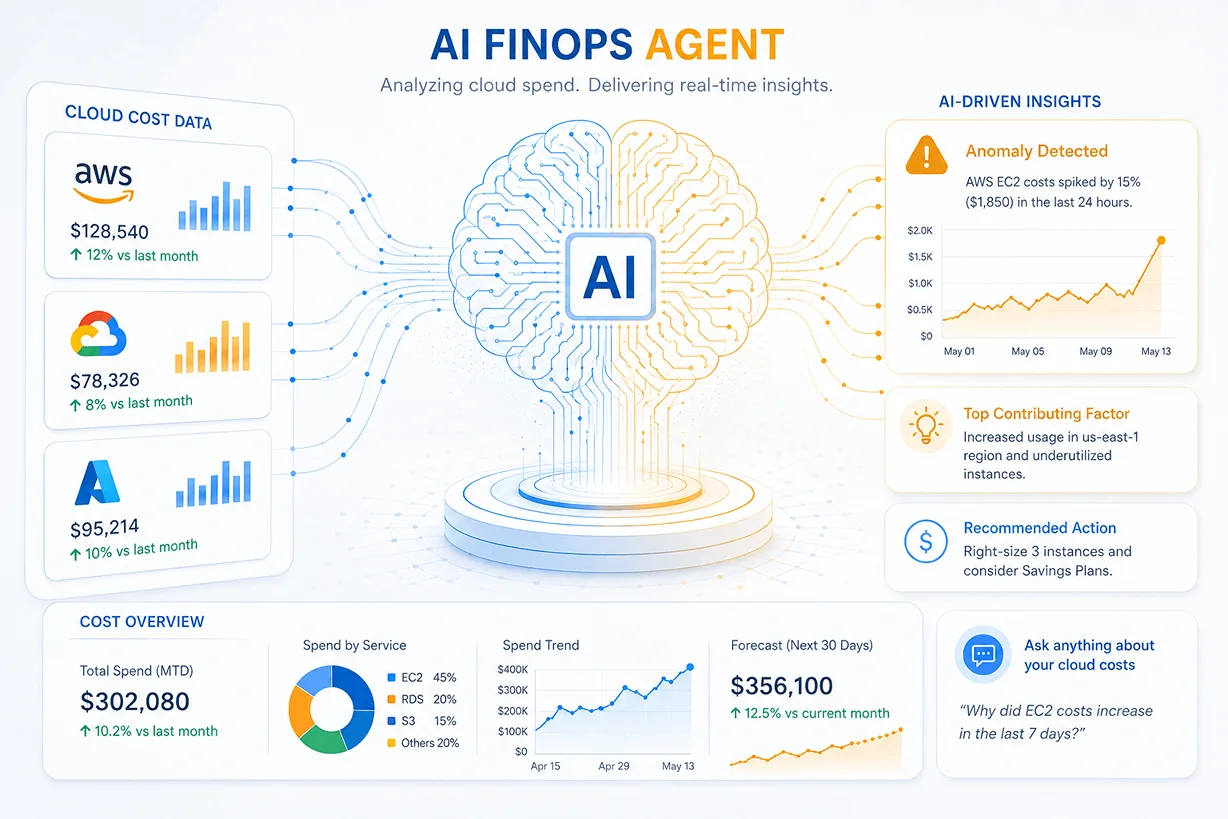
One of the most powerful contributions of AI to FinOps is real-time anomaly detection. Cloud bills can surge overnight due to a misconfiguration, an unexpected usage spike, or simply forgetting to turn off a resource. AI tackles this by monitoring spend patterns continuously and acting the moment something looks off.
Detect
Spot the anomaly
Analyze
Find the root cause
Act
Remediate automatically
Learn
Refine over time
Real-time anomaly alerts
AI-driven systems establish a baseline of normal cloud spending behavior and immediately identify outliers. For instance, if your Azure storage costs usually hover around $200/day and suddenly jump to $600, an AI service will detect this deviation within hours (or minutes) and send an alert. This timeliness allows startups to investigate before a minor glitch turns into a major bill. Microsoft, Google, and AWS all offer cost anomaly detection tools, and third-party platforms enhance these with ML algorithms for higher precision and fewer false alarms.
Root cause analysis with AI
Detection is step one – understanding why the anomaly happened is step two. Generative AI can assist by correlating the cost spike with other data: deployment logs, monitoring alerts, or changes in usage. As a use case, imagine an AI FinOps agent finds an unusual surge in GCP networking costs. It might correlate this with a recent deployment and discover an improperly configured data pipeline causing excessive cross-region data transfer. The AI could then explain the root cause in simple terms and even suggest the fix (e.g., enable caching or adjust the data retention settings that caused the spike).
Automated remediation workflows
Here's where smart workflows truly shine. Upon detecting a cost anomaly and diagnosing it, an AI agent can execute (or recommend) a remediation via automation. For example, if an idle development server is chewing up costs over the weekend, the AI could automatically shut it down and tag the owner on Slack with a note on cost savings achieved. In one scenario highlighted by a FinOps platform, an AI agent not only flagged a storage cost spike but also initiated a correction – scaling down a misconfigured backup job after policy approval. These kinds of closed-loop workflows—detect, analyze, act—dramatically reduce cloud waste without waiting for human intervention. As one industry expert put it, this "autonomous anomaly detection and problem resolution" is like having a virtual FinOps engineer on duty 24/7.
Continuous learning
Smart FinOps workflows get better with time. AI models learn from each incident, refining what counts as "normal" and improving recommendations. If an anomaly is a false positive, the AI adjusts its thresholds; if a new pattern of waste emerges (say, a recurring unused test cluster every Friday), the AI will start catching it earlier. This means your cloud cost optimizations actually improve continuously – a huge advantage over static rules.
The upshot for startups is significant. By deploying AI for anomaly detection and coupling it with automated fixes, even a small FinOps or DevOps team can manage cloud environments of great complexity with confidence. You catch the small fires before they blaze into budget infernos. Cloud waste is reduced through immediate action, and engineers are freed from firefighting to focus on building product.
Smart Workflows that Reduce Cloud Waste
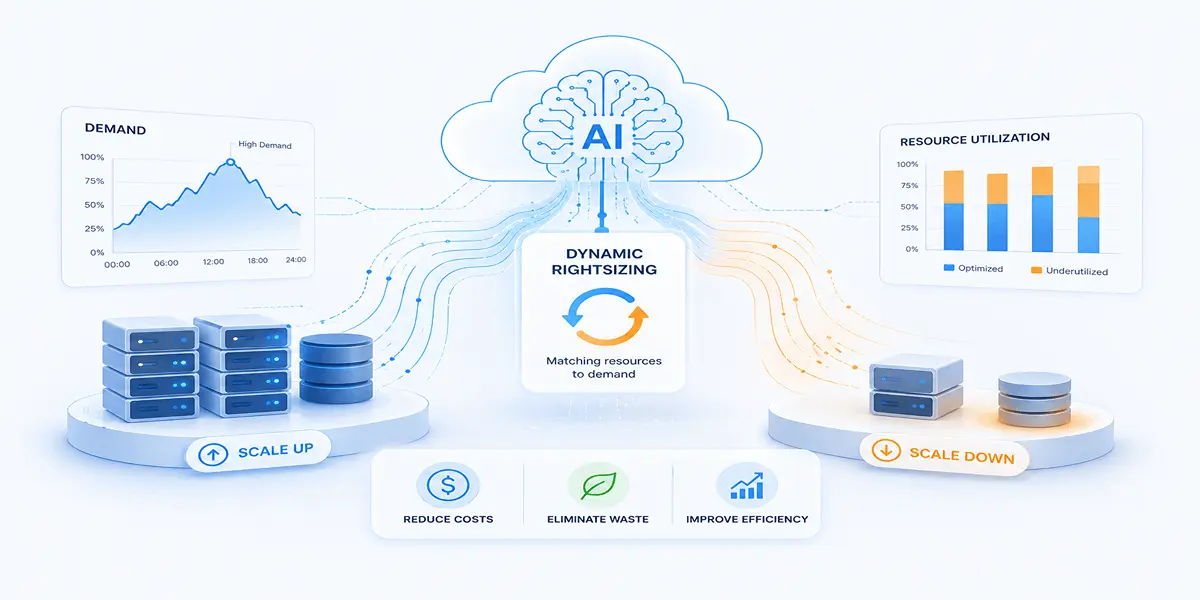
What do we mean by smart workflows in FinOps? It's the idea of connecting observations to actions in a seamless, automated loop. Generative AI acts as the brain, and your cloud environment is the body it directs. Here are a few examples of smart workflows that early- and growth-stage startups are leveraging to cut waste and streamline FinOps.
Automated resource scheduling
Startups often have development or testing environments that don't need to run 24/7. A smart workflow can use AI to detect non-production resources and automatically schedule them to shut down during off-hours (and spin up when needed). This simple step, powered by an AI understanding of usage patterns, can trim 20-30% of waste in multi-cloud environments by eliminating idle time.
Intelligent rightsizing
Instead of manual reviews of instance utilization, an AI agent continuously evaluates each VM, database, or container's utilization metrics. When it finds an oversized resource (say an 8xlarge instance averaging 5% CPU), it triggers a rightsizing workflow to recommend a smaller size or adjust autoscaling rules. Over time, these incremental adjustments save significant costs while maintaining performance.
Cross-cloud optimization
In multi-cloud startups, a smart workflow might even orchestrate across AWS, Azure, and GCP to take advantage of the best pricing or features. For example, if AWS spot instances become cheap, the AI could shift a batch workload to AWS from Azure temporarily, then shift back – all within policy bounds. Generative AI's planning capability can simulate such scenarios and execute if it makes financial sense – a mini "cloud cost trading engine" that was previously only feasible for large enterprises.
Policy-driven cost controls
Smart workflows also enforce cost guardrails automatically. If a developer tries to deploy a resource that violates cost policies (e.g., launching a GPU instance without approval), the AI can intercept that event through integration with CI/CD or cloud APIs, halt the deployment, and route a request for exception – baking FinOps controls into DevOps workflows and reinforcing a cost-aware culture.
Each of these workflows reduces human error and ensures cloud cost optimization is not a one-time project but a continuous process. The beauty for startups is that these intelligent processes run in the background, saving money quietly but significantly. As one FinOps tool provider noted, advanced platforms now offer "hyper-automation" – essentially one-click execution of cost-saving actions across environments. In practice, this is generative AI doing the heavy lifting of cost management so your team can focus on growth.
Real-World Use Cases for Startups
To ground this in reality, let's consider a couple of simplified examples of how early-stage and growth-stage companies can benefit from bridging FinOps with generative AI.
Lean startup with no FinOps team
A 15-person SaaS startup on AWS and GCP can't afford a dedicated FinOps engineer, so they implement a generative AI cost agent. Within weeks, it rightsizes over-provisioned VMs, schedules dev/test servers to turn off at night, and fixes inconsistent tagging hiding two orphaned databases – cutting spend by 25% with virtually no manual effort, backed by a weekly plain-English report the founders share with investors.
Growth-stage startup scaling multi-cloud
A Series B fintech startup spans AWS, Azure, and GCP, making cost tracking difficult. An AI FinOps platform flags a sudden Azure cost spike, traces it to an overnight load test, and stops it automatically. Its forecasting model also warns of a looming budget overrun and recommends Savings Plans – saving hundreds of engineer hours so the tech team can focus on features instead of cost analysis.
These examples underscore a common theme: AI agents for cloud cost optimization act as force multipliers for startups. They catch what humans miss, execute tasks at machine speed, and enforce best practices consistently. The payoff is not just cost savings, but also operational agility – the company can scale without the worry that cloud complexity will lead to runaway costs.
Loves Cloud: Your Partner in GenAI-Powered FinOps
Bridging FinOps and generative AI may sound complex, but you don't have to go it alone. Loves Cloud specializes in exactly this intersection – offering GenAI agent implementation and cloud cost management expertise to help startups realize these benefits in practice.
As a cloud and AI consulting partner, our team brings deep FinOps know-how and hands-on experience with the latest AI tools to craft solutions tailored for your business needs – whether that's a co-pilot monitoring AWS, Azure, and GCP costs 24/7, or guidance on improving tagging and budget policies with AI insights.
- Intelligent tagging systems built and rolled out
- Automated cost dashboards tailored to your stakeholders
- Anomaly response workflows saving money from day one
- Financial governance and cost optimization that scales with you
Conclusion
In summary, bridging FinOps and generative AI unlocks a new level of cost efficiency for startups. By enhancing cost governance, automating tagging, improving reporting, and turbocharging anomaly detection, AI-driven smart workflows address cloud waste in ways traditional methods simply can't. Startup CTOs and FinOps teams gain an executive-friendly, proactive stance on cost management – keeping cloud expenses in check without drowning in manual effort. The technology is here, and early adopters are already seeing significant savings and smoother operations.